

Table of
Contents
1. Introduction
2. Kempen Engagement Behaviour
3. Manager voting and engagement behaviour
4. Governance
1. Introduction
The Trustee recognises its responsibility as an owner of capital, and believes that good stewardship practices, including monitoring and engaging with investee companies, and exercising voting rights attached to investments, protect and enhance the long-term value of investments. The Trustee has delegated to its fiduciary manager and asset managers the exercise of rights attached to investments (including voting rights), and engagement with issuers of debt and equity and other relevant persons about matters such as performance, strategy, capital structure, management of actual or potential conflicts of interest, risks and environmental, social and governance (ESG) considerations.
ESG criteria are a set of non-financial indicators relating to a company’s operations that are used by investors to evaluate corporate behaviour and determine how it may impact the future financial performance of companies. Environmental criteria consider how a company performs as a steward of nature. Social criteria examine how it manages relationships with employees, suppliers, customers, and the communities where it operates. Governance deals with a company’s leadership, executive pay, audits, internal controls, and shareholder rights.
This statement provides information on how, and the extent to which, the Sole Trustee of Cullum Detuners Limited Retirement Benefits Scheme (the “Trustee”) acting in its capacity as Trustee of the Cullum Detuners Limited Retirement Benefits Scheme (the “Scheme”), has followed good stewardship practices during the five months from 1st November 2020 to 31st March 2021. This is in accordance with new requirements established by the Shareholder Rights Directive (SRD II), as it applies to occupational pension schemes. SRD II aims to promote effective stewardship and long-term investment decision-making.
The Trustee does not monitor or engage directly with issuers or other holders of debt or equity. The Trustee expects the fiduciary manager, Kempen Capital Management (“Kempen”) to exercise ownership rights and undertake monitoring and engagement in line with its own corporate governance policies, taking account
of current best practice including the UK Corporate Governance Code 2018 and the UK Stewardship Code 2020.
The fiduciary manager expects the underlying asset managers it selects, who are regulated in the UK, to comply with the UK Stewardship Code 2020, including public disclosure of compliance via an external website. For an asset manager to be appointed by Kempen, on behalf of the Trustee, they must also take into consideration Kempen’s’ Responsible Investment and Exclusions policy which can be found here – https://www.kempen.com/en/asset-management/esg
The Trustee is conscious that some asset managers may not be able to provide voting records for all investment held within certain pooled structures or for specific time periods. It is engaging with them, via Kempen, to improve the collection and reporting of this data.
2. Kempen engagement behaviour
The Trustee encourages its asset managers to actively engage with the companies in which they invest. This engagement is on a number of different topics including but not limited to remuneration policy, corporate governance, transparency, and other ESG topics such as working conditions and climate change. These engagement activities are carried out by each underlying asset manager in accordance with their own responsible investing (RI) policy, while the Trustee also expects Kempen to engage with those asset managers on behalf of the Trustee.
Kempen’s engagement with asset managers on behalf of the Trustee is a continuous process. Whilst Kempen has limited influence over the asset managers’ investment practices where assets are held in pooled funds, it does encourage its chosen managers to improve their practices and consider ESG factors and their associated risks. Kempen uses the following methodology to engage with asset managers.
– ESG criteria is assessed based on international conventions and initiatives, such as the UN Global Compact and the Principles for Responsible Investment (PRI);– All managers are screened against ESG criteria before inclusion in the Kempen’s approved manager list. For example:
– does the manager have a responsible investment policy;
– is the manager open for a dialogue on ESG criteria, and does the manager have exposure to companies that are on Kempen’s exclusion & avoidance list?
– All managers are reviewed against ESG criteria on an ongoing basis. For example:
– are responsible investing considerations continue to be integrated into their investment process
– is the manager making progress;
– is the manager well informed and up-to-speed of ESG criteria and initiatives;
– periodic screening of all the underlying equity and debt securities held by managers within their investment products, to check for exclusion candidates.
– Kempen encourages its chosen managers to improve their practices where appropriate.
The Trustee, via Kempen, is also involved in various collective engagement initiatives working collaboratively with peer investors and other stakeholder organisations to amplify their impact and make transformative change happen on a global scale. Kempen is an active member and a lead investor in a number of collaborative engagements including:
– Climate Action 100+ – An influential investor initiative asking over 100 of the world’s largest corporate greenhouse gas emitters to drive, and not impede, the clean energy transition – EUMEDION – The Dutch Corporate Governance Forum, which led on the development of the Dutch Stewardship Code.
– Platform Living Wage Financials (PLWF) – An award-winning investor supported coalition, which Kempen is a co-founder of, to monitor and assess garment sector companies and encourage them to enable a living wage for all employees in their supply chain.
– Principles for Responsible Investment (PRI) – The PRI is the world’s leading proponent of responsible investment. The Principles were launched in April 2006 and Kempen joined in 2008. Since then the number of signatories has grown from 100 to over 2,300 with a combined AUM of $90 trillion.
– International Corporate Governance Network (ICGN) – An investor-led organisation to promote effective standards of corporate governance and investor stewardship. Kempen is a member of the Board Governance Committee.
– Global Impact Investing Network (GIIN) – An investor network dedicated to increasing the scale and effectiveness of impact investing around the world.
– FCLT – FCLTGlobal is a not-for-profit organization that works to encourage a longer-term focus in business and investment decision-making.
– 300 Club – The 300 Club is a group of leading investment professionals s from across the globe, established in 2011 in response to an urgent need to raise uncomfortable and fundamental questions about the very foundations of the investment industry and investing.
– Pensions for Purpose – Pensions for Purpose exists as a bridge between asset managers, pension funds and their professional advisers, to encourage the flow of capital towards impact investment.
In 2020, Kempen’s asset management portfolios became less carbon intensive. As the coverage of the carbon footprint analysis of its assets under management grew to EUR 34.2 billion (2019: EUR 27.3 billion), the total financed carbon emissions stayed at the same level (2020 and 2019: 3.4 million tonnes of CO2e). The lower carbon footprint was not only seen in internally-managed Kempen funds, but also in external funds as a result of more (institutional) clients preferring to invest in assets with lower carbon intensity. Kempen expects that this development will continue going forward with the increasing ESG and climate focus from regulators
Key highlights for 2020
Climate change
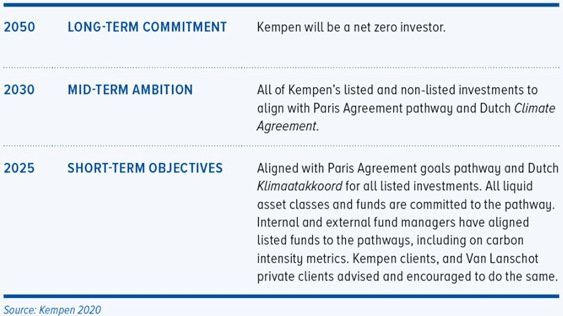
The UN estimated last year that global emissions must fall at least 7.6% every year to 20301 to limit global warming to 1.5 ᵒC. COVID-19 lockdowns across the world resulted in a reduction in carbon emissions at the start of the pandemic, but these have been steadily climbing up again as industrial activity has returned. A number of nations and corporations announced commitments to become net zero carbon emitters in 2020, including the world’s largest CO2 emitter, China. Kempen has been measuring the carbon footprint of its assets under management since 2017, and in 2020 published its Climate Change Policy2 which made Kempen one of the first asset managers to commit to net zero emissions by 2050, along with intermediate ambitions for 2030, and shorter-term objectives to 2025.
In 2020, Kempen’s asset management portfolios became less carbon intensive. As the coverage of the carbon footprint analysis of its assets under management grew to EUR 34.2 billion (2019: EUR 27.3 billion), the total financed carbon emissions stayed at the same level (2020 and 2019: 3.4 million tonnes of CO2e). The lower carbon footprint was not only seen in internally-managed Kempen funds, but also in external funds as a result of more (institutional) clients preferring to invest in assets with lower carbon intensity. Kempen expects that this development will continue going forward with the increasing ESG and climate focus from regulators.
Kempen engagement activity
Companies
In 2020 Kempen engaged directly with 116 companies on environmental, social and governance themes.Of these engagements, 82 were direct engagements by Kempen’s portfolio managers and responsible investment team. Kempen also engaged with an additional 206 companies in collaboration with peers. Dialogue with companies is divided into ‘engagements for change’ and ‘engagements for awareness’. The engagements for change were focused mainly on environmental (45%) and governance issues (37%).Kempen also engaged with 41 companies for awareness on general ESG issues, for the most part on governance and often around AGM agenda items.
For further details of engagement, please click on the link https://www.kempen.com/en/asset-management/esg/engagement-factsheets
Throughout 2020, Kempen voted at 419 distinct company meetings, with 14% of votes cast against
management. There were 280 meetings (64.37%) where Kempen voted against at least one agenda item, or withheld / abstained on at least one point.
Number of votes on Shareholder Proposals 145
Number of votes FOR shareholder proposals 71
Of the 71 FOR shareholder votes, 8 related to corporate governance (including the gender pay gap), 10 required independent chairperson, 7 focused on climate change, 6 on social proposals, 13 on shareholder rights, and 9 related to political lobbying disclosure.
External managers – general
In recent years, Kempen has been developing a new framework for assessing stewardship and ESG, whichculminated in the introduction of its Sustainability Spectrum in 2020. It is used to determine a sustainability score for investee companies and a range of different financial products (e.g.externally managed funds). This helps to define whether the product or service is one that aims only to ‘avoid harm’ (a score of 3 –which is now a requirement for all external products), or whether it is more ambitious in its sustainability goals.
The five levels of sustainability spectrum are:
1. Compliant
The solution offered to the client meets legal requirements but there is no proactive consideration to ESG factors beyond this.
2. Basic
The investment takes minimal steps to go beyond compliance inorder to avoid reputational risks.
3. Avoid harm
In this approach the client is an active owner with a clear client and stweardship policy in place, and the investments take ESG factors in to consideration with some balance between risk and return, cost and sustainability. ESG integartion is not a primary driver of decision-making but clients invest sustainably and avoid harm. Active ownership appraoch including engagement and own voting policy is actively encouraged.
4. Do better
In this level clients intention is to benfit stakeholders. The goal is to build a sustainable portfolio for the client. The investment applies an inclusion or a best in practise approach with sustainability ambition translated into policy, implementation and reporting. Climate related ambition are set. Higher thresholds of exclusions in areas such as animal welfare, labour and human rights and environmental harm are applied. Active ownership including a strong engagement and ambitious voting policy is expected.
5. Do good
In this level, client’s intention is to contribute to solutions to global sustainability challenges such as the Sustainable Development Goals. The investments drive positive real world outcomes on client’s behalf. This tends to be in the form of a thematic or SDG-aligned investment approach, and investee companiues are expected to derive a certain proportion from revenues from a sustainability solutions.
In 2020, Kempen started to use the new Sustainability Spectrum to score external managers. It was decidedthat the manager selection and monitoring team would begin by mapping the listed managers they workwith. By the end of the year, they had completed scoring for 83 listed funds based on the new framework,which represents around 24% of Kempen’s AuM. As a percentage of AuM: 2% of the funds scored Basic(score 2); 15% scored Avoid harm (score 3); 7% scored Do better (score 4); <1% scored Do good (score 5). Thedistribution of the 83 funds’ ESG scores between the five Sustainability levels are: 26% Basic; 52% Avoidharm; 18% Do better; and 4% Do good (score 5)
3. Manager voting and engagement behaviour
The Shareholder Rights Directive (SRD II) and The UK Stewardship Code 2020 both emphasise the importance of institutional investors and asset managers engaging with the companies in which they invest, and stress the importance of exercising shareholder voting rights effectively.
The Trustee encourages all their asset managers to be engaged investors, and furthermore encourages the managers to report on these activities and to disclose information about Responsible Investing on their website and in their client reports.
The intention of this section of the Statement is to provide specific details of the voting and engagement behaviour including examples of some significant votes of the Scheme’s underlying asset managers, by fund, during the five months from 1st November 2020 to 31st March 2021.
3.1 Equity Managers’ Responses
More detail on UBS’s voting policy and voting record can be found at: https://www.ubs.com/global/en/asset-management/investment-capabilities/sustainability.html
3.2 Bond Managers’ Response
Insight
Insight participates in a range of associations and collaborative initiatives, including as a founding signatory to the UN-supported Principles for Responsible Investment (PRI), as well as the UK Stewardship code.3
During 2020, Insight’s credit team amended one of their key investment tools, the ‘landmine checklist’, to include climate risk as a discrete risk alongside ESG and other credit-material factors. This addition will ensure all debt investments will now also be assessed based on their exposure to transitional or physical climate risk.
Insight continue to avoid tobacco companies within their strategic credit portfolios, while they also continued a range of long-term engagements with different companies on behalf of their fixed income investors. Overall, there were4:
- 1,210 instances of engagement over 2020, of which 90% included some form of ESG dialogue;
- This included companies from 64 countries, including 30 from emerging markets;
- 33% of the meetings were with Insight exclusively;
- 61% of these meetings included the company’s board or senior
In one example, Insight ended up selling debt holdings in the freight transportation company Burlington Northern Santa Fe Railway Company within their strategic credit portfolios. Relative to its peers and standard market practice, Insight feel that the issuer’s governance rating is weak. They sought to engage with the company to better understand its approach and encourage improvement, but given the lack of willingness to engage, coupled with their belief that the bonds were not trading in line with these risks, they decided to exit their position.
Insight also take a proactive role in ensuring the long-term sustainability and resilience of the markets in which they operate, by engaging on significant regulatory issues. This has included engagement on RPI reform, which Insight believe could have negative implications for millions of UK pensioners. Insight’s aim has been to draw attention to the potential impact of the proposed change and to ensure everyone has an opportunity to make their voices heard. Despite their efforts, in November 2020 the UK government announced it would go ahead with planned reforms, with the RPI/ CPIH alignment beginning from 2030.
Aegon
Building on their rich heritage of responsible investment stretching over the past 30 years, they have built a comprehensive responsible investment approach consisting of three pillars: ESG integration, active ownership and solutions. They integrate ESG factors across their investment platform*, lead active ownership activities and provide focused responsible investment (RI) solutions.
Through their comprehensive responsible investment activities, they aspire to help their clients pursue better long-term outcomes while contributing to sustainable capital markets and impactful economic activities.
Full details can be found here Responsible Investing | Aegon Asset Management (aegonam.com)
LGIM
LGIM believe environmental, social and governance (ESG) factors – such as climate change, social inequality and executive pay – are financially material. So they see responsible investing as the incorporation of ESG considerations into investment decisions.
Responsible investing, in their view, is essential to mitigate risks, unearth investment opportunities and strengthen long-term returns for clients. It is also core to their approach: their very purpose at LGIM is to create a better future through responsible investing.
Full details can be found here Responsible Investing | LGIM Institutional
3.3 Alternatives Managers’ Response
Partners Group
Partners Group has always understood the importance that sustainability can have to long-term investing and, specifically, to risk assessment. That is why oversight for sustainability topics lies with the most senior levels of their organisation, their Board of Directors and Executive Committee. Corporate- and investment- related ESG topics are discussed at least once a year by their Board-level Investment Oversight Committee and on an ongoing basis by their Executive Committee, which meets once a week. Topics discussed at both Board and Executive Committee level include human capital development, ESG risks and opportunities within their investments and beyond, cybersecurity, business ethics, regulatory developments and climate change, among others.
Full details can be found here – Sustainability (partnersgroup.com)
Kempen Diversified Structured Credit Pool
As of May 2021, following continuous engagement with the underlying managers, all underlying managers in the Kempen Diversified Structured Credit Pool (DSCP) are now signatories to the UN-backed Principles for Responsible Investment (“PRI”). Kempen sees this as an important step in its journey to further integrate ESG factors into investment decision-making in DSCP, a multi-manager fund that invests in a concentrated pool of long-only Structured Credit funds. In addition to performing annual ESG due diligence on managers, Kempen actively shares its sustainability knowledge and expertise with underlying managers, leading to active engagement discussions on topics such as ESG integration and analysis or calculating the carbon footprint of portfolios.
As an example, to further enhance the ESG profile of its funds, Kempen has recently agreed with one of its underlying managers that it will invest at least 10% of the portfolio in Green ABS that fit the risk/reward criteria of the mandate.
Notwithstanding the above, Kempen recognises that incorporating ESG factors in the investment process of Structured Credit investments is not as straightforward as for corporates issuing traditional equity and debt. While companies are actively managed and in constant dialogue with their shareholders and stakeholders, in the case of securitisations there are several parties to a transaction (e.g. originator, servicer, trustee, swap counterparty), all of which tend to have limited decision-making power and must follow the prospectus when resolving issues (e.g. control) in a trust. And by design, in Structured Credit, the issuer is a special purpose vehicle with no management team. Moreover, underlying loan pools can have thousands of individual loans.
As governance (“G”) tends to be well covered, Kempen sees most incremental value in focusing on the Environmental (“E”) and Social (“S”) factors. Nowadays various instruments across Structured Credit sectors have been issued with an ESG label, aiming to finance relatively more environmentally-friendly loan pools or for social impact (e.g. providing mortgage financing to underserved borrowers). Examples of such instruments would be Solar ABS, where homeowners take out a lease for their solar system which leads to lower monthly utility payments; Green CMBS, where financing goes to green commercial buildings that target energy and/or water efficiency reductions; and Social RMBS where financing goes to self-employed borrowers, first-time buyers, younger borrowers or contractors. in other words people that have a ‘complex’ income profile.
In 2021 Kempen intensified its engagement efforts with DSCP managers. Through this engagement Kempen explained the benefits it sees in the managers adopting the PRI principles, and the learning and resources opportunities. Furthermore, it explained the PRI reporting requirements and how to go about collecting and
16
31 MARCH 2021
integrating ESG data, ratings and carbon data. The engagements were successful, with two managers finalising their responsible investment policies and signing up to the PRI.
4. Governance
The Trustee meets formally three times a year (and more often if required) to consider the progression of the funding position and investment performance. This will include a review of the performance of the assets relative to objectives and underlying risks, the economic outlook, and the manner in which the assets are invested. To aid this review, the Trustee will primarily rely on reports and advice received from Kempen.
Review of SIP
The Trustee reviews the SIP after consultation with their professional advisers once every three years, and in response to any significant change in professional advisors or investment policy. The SIP was last updated in September 2020 with the transition to a Fiduciary Management arrangement with Kempen Capital Management.
Adherence to the SIP
The Trustee will monitor compliance with the SIP annually. In particular they will obtain confirmation from Kempen that they have complied with the SIP insofar as is reasonably practicable and that in exercising any discretion they have done so in accordance with Section 4 of the Occupational Pension Plan (Investment) Regulations 2005.
The Trustee is of the opinion that their investment objectives set out in their SIP have been followed during the year. In particular:
- The Trustee has received reports from Kempen that set out:
- How Kempen has engaged with asset managers on behalf of the Trustee;
- Kempen’s engagement priorities on responsible investing;
- The number of companies and managers
- The Trustee has considered Kempen’s voting practices and stewardship policies, noting that they are a signatory to the UN Principles for Responsible
- The Trustee has a process in place to review Kempen’s performance against
In light of the above, the Trustee has considered its investment objectives in regard to voting and stewardship and concluded that:
- Kempen’s voting and stewardship policies and implementation remain aligned with the Trustee’s views on these
- The current investment objectives are appropriate and no further action is
Signed …………………………………………………… Name ………………………………………………………
Signed …………………………………………………… Name ………………………………………………………
on behalf of the Trustee of the Cullum Detuners Limited Retirement Benefits Scheme.
18
31 MARCH 2021
Kempen Asset Management
3 Please see Responsible investment | Insight Investment
4 Data provided by Insight Investment
14
31 MARCH 2021